If you run a clinic, urgent care, multi-site practice, or specialty group, you already know the two problems that keep coming back:
Your phone system has to be secure and dependable — with encrypted call audio, audit-logged recording, defined retention, and access controls that actually hold up under review.
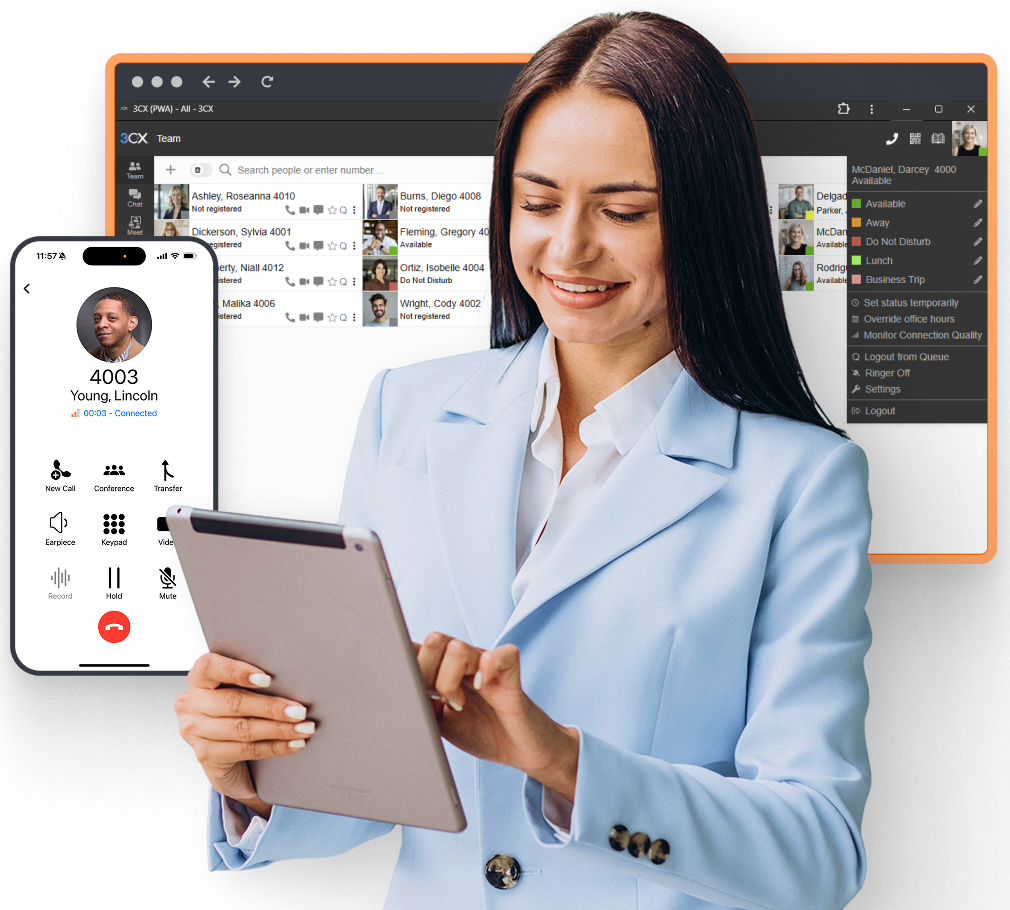
It has to work the way your clinical and front-desk teams already work — inside the EHR, across multiple locations, with reliable after-hours routing and zero tolerance for downtime during patient care hours.
Most VoIP providers solve one of those problems. Many don’t solve either particularly well — they put a “secure” checkbox on a spec sheet and call it a day.
Techmode does this differently. We work directly with healthcare practices to design phone systems that fit the actual workflow of clinicians, intake coordinators, billing staff, and care teams. And we stay involved long after the install. For a broader view of how we approach the industry, see our healthcare communications overview.
What secure healthcare communications actually looks like
A lot of healthcare buyers get burned because “secure” gets used as marketing language with very little behind it. Here’s what actually matters:
Reliable uptime during patient care hours
We design around your clinical schedule. Downtime during office hours isn’t acceptable — and we treat it that way.
Encrypted voice traffic
(SRTP/TLS)
So call audio and signaling can’t be intercepted in transit.
Secure call recording storage
With access controls, audit logs, and retention policies that match your compliance program.
Role-based user permissions
So a front-desk user can’t access recordings tied to clinical conversations they shouldn’t hear.
Secure voicemail handling
Including encrypted voicemail-to-email and the option to disable transcription where PHI risk is too high.
The underlying architecture matters too — private instance vs. multi-tenant cloud has direct implications for how PHI is isolated and protected. We walk you through every one of these during onboarding. You don’t have to be the technical expert — that’s our job.
EHR integration:
The difference between a working system and a frustrating one
This is where most providers fall short. A phone system that doesn’t connect to your EHR forces clinical staff to bounce between screens, retype patient information, and lose context mid-call.
Techmode supports integrations and click-to-call workflows with the major EHR platforms used across SMB healthcare — athenahealth, eClinicalWorks, NextGen, Kareo, DrChrono, AdvancedMD, Practice Fusion, and others. For practices on Epic or Cerner, we coordinate with your IT team to make sure call data flows where it needs to go.
The goal is simple: when a patient calls, your team should have the context they need, fast. When a clinician needs to return a call, it should take seconds — not navigation through two separate systems.
Many of the healthcare organizations we work with operate across two, five, or fifteen locations. They need:
Shared extensions and unified directories
Across every site.
Intelligent call routing
For example, overflow from a busy clinic rolling to a sister location instead of voicemail.
Centralized after-hours and on-call routing
That respects provider schedules.
Consistent caller ID and call handling
So patients have one experience regardless of which office they dial.
This is where a high-touch provider beats a self-service platform. We map your call flows with you, document them, and adjust as your practice grows or restructures. You’re not logging into a portal at 7 AM trying to rebuild an IVR before patients arrive.
Why practices switch to Techmode from
RingCentral, Nextiva, and legacy PBX systems
The two reasons we hear most often from healthcare buyers:
Support fell off a cliff.
With larger providers, the sales process is great and then you become a ticket number. When a phone issue is also a patient-safety issue, that’s not acceptable.
The system never quite fit.
A generic UCaaS deployment doesn’t account for EHR workflow, multi-site routing, or after-hours coverage unless someone takes the time to design it that way.
Techmode is intentionally built around that gap. You get a dedicated point of contact, transparent pricing (we’ll quote you in writing, line by line), and a team that knows healthcare deployments specifically. If you’re still mapping out the move off of an aging PBX, our breakdown of the evolution from on-prem PBX to cloud UCaaS and CCaaS is a useful starting point.