
Evaluating Your Mitel Solution Contract?
Mitel’s bankruptcy and product discontinuations have IT leaders asking the right questions. Before your next renewal, understand what’s changed—and what options exist.

Latest Blogs

The Mitel-RingCentral Deal Fell Apart. Now What?

Your Mitel System Has an End of Life Timeline — Here’s Exactly When the Clock Runs Out

UCaaS Hidden Fees and Taxes: What Your Quote Is Missing (And Who Pays for It)

Hidden AI Fees in VoIP: How “Affordable” Tools Become Budget Nightmares

What Mitel Customers Need to Know
Mitel’s Chapter 11 bankruptcy filing in March 2025, combined with end-of-life announcements for products like MiVoice Connect, hasn’t happened in a vacuum. These developments follow years of strategic shifts—the sale of their UCaaS business to RingCentral, restructuring of partnerships, and product consolidation. For IT leaders responsible for mission-critical communications, these aren’t just headlines—they’re planning factors.
Three Key Developments
Financial Restructuring
Mitel emerged from Chapter 11 bankruptcy after restructuring $1.15 billion in debt. While operations continue, the restructuring raises questions about long-term innovation investment and product roadmap stability.
What this means for you: Contract terms, support commitments, and upgrade paths may shift as the company prioritizes profitability over R&D spend.

Product End-of-Life Decisions
MiVoice Connect reached end-of-life in July 2024. Customers on legacy platforms face limited upgrade paths, with many requiring complete platform migrations rather than simple version updates.
What this means for you: If you’re on MiVoice Connect or other legacy Mitel products, your next “upgrade” might require the same effort as switching providers entirely.
Complicated Product Portfolio
Mitel’s acquisition history (ShoreTel, Unify, and others) created a fragmented product lineup. Support quality varies significantly depending on which Mitel platform you’re on, and integration between products remains challenging.
What this means for you: IThe “Mitel” you signed up for might be fundamentally different from the Mitel you’re actually using, especially if your system came through acquisition..
None of this means Mitel is disappearing tomorrow. But if your contract is coming up for renewal, or you’re experiencing any of the challenges below, it’s worth understanding what alternatives exist—even if you ultimately stay with Mitel.
What to Evaluate Before Your Next Mitel Renewal
Contract renewal shouldn’t be automatic. Whether you stay with Mitel or explore alternatives, these questions help ensure you’re making an informed decision rather than defaulting to the status quo.
What's Your True All-In Cost?
Don’t just look at your monthly per-user fee. Calculate:
- On-premises hardware maintenance and refresh costs
- Professional services fees for moves, adds, changes
- Support contract costs beyond basic service
- Hidden fees (E911, number porting, admin portal access)
- Opportunity cost of IT time managing the system
Mitel Reality Check: Many organizations on legacy Mitel deployments (especially on-premises or hybrid) discover their “low” per-user cost doesn’t account for the full burden of maintaining aging infrastructure. A pure cloud solution might show higher per-user costs but significantly lower TCO.
What Support Level Are You Actually Getting?
Support quality varies dramatically across Mitel’s product lines:
- Response times for critical issues
- Availability of engineers vs. tier-1 script-readers
- Proactive account management vs. reactive ticket handling
- Offshore vs. domestic support teams
Key Questions to Ask Mitel:
- What’s our average time-to-resolution for P1 issues?
- Who is our dedicated account manager, and when did they last check in?
- What percentage of our support tickets require escalation beyond tier 1?
Does Your Current System Support Your Actual Work Environment?
The pandemic changed how we work. Does your Mitel deployment support:
- Fully remote employees across distributed locations?
- BYOD policies and mobile-first workers?
- Modern collaboration integrations (Teams, Slack, CRM)?
- Seamless video meetings without juggling multiple apps?
Mitel Consideration: If your Mitel deployment is primarily on-premises, how well does it truly support your distributed workforce? Are remote workers forced onto VPNs or using workarounds?
What's Your Exit Strategy If Things Change?
Before renewing any contract, understand:
- Contract term length and auto-renewal clauses
- Early termination fees and conditions
- Number porting procedures and timeline
- Data export capabilities (call recordings, configurations, analytics)
- What happens if Mitel discontinues your specific product
Critical for Mitel Customers: With multiple product lines and end-of-life decisions already announced, make sure you understand your migration path—whether that’s within the Mitel ecosystem or to a different provider.
How Does Mitel's Innovation Roadmap Compare?
Cloud UCaaS has evolved rapidly. How does your Mitel system compare on:
- AI-powered features (transcription, sentiment analysis, routing)
- Native integrations with business tools you actually use
- Mobile app functionality and user experience
- Regular feature releases vs. multi-year upgrade cycles
Be Honest: When was the last time Mitel released a feature that meaningfully changed how your team works? If you can’t remember, that’s your answer.
Are You Getting Value or Just Avoiding Change?
The hardest question: Are you staying with Mitel because it’s genuinely the best option, or because switching seems overwhelming?
Consider:
- How many hours per month does your IT team spend managing or troubleshooting your phone system?
- How many features are you paying for but not using?
- How many workarounds have become “just how we do things”?
- If you were choosing a system today with no sunk costs, would you still choose Mitel?
What to Evaluate Before Your Next Mitel Renewal
We’re not here to attack Mitel—they’ve been in business 50+ years for good reasons. But the UCaaS landscape has changed dramatically. Here’s an honest comparison of legacy Mitel deployments against purpose-built cloud platforms.
Key Differentiators

Financial Stability Without Restructuring Baggage
We’re not carrying billions in acquisition debt. Our investment goes into product development and support, not debt service.

Purpose-Built for Cloud
Instead of retrofitting on-premises tech for cloud, we designed for cloud from day one. Better reliability, easier updates, features that actually work together.

Support That Knows Your Name
85 NPS vs. industry average of 36. U.S.-based dedicated technician. No offshore call centers or tier-1 script readers.
Should You Switch, Stay, or Wait? Find Out in 2 Minutes
Not every Mitel customer needs to switch immediately. But understanding your options—objectively—helps you make the right decision for your specific situation.
Assessment Value Proposition

Understand Your Situation
- Risk assessment based on your Mitel product
- Contract analysis (timing, terms, exit costs)
- TCO comparison for your deployment
- Support quality evaluation

Get Custom Recommendations
- Should you switch, stay, or wait?
- Timeline and budget planning
- Migration complexity assessment
- ROI analysis for making a change

No Pressure, Just Facts
- Objective analysis, not a sales pitch
- Understand your options clearly
- Make an informed decision
- No obligation to move forward
Not ready? Download our Mitel evaluation guide
Want to talk first? Schedule a consultation
If You Do Decide to Switch, Here's What to Expect
Let’s address the elephant in the room: switching phone systems sounds daunting. Here’s the honest reality of what migration actually involves.
Common Migration Fears
- "Our business can't afford downtime"
- "We'll lose our phone numbers"
- "It will take forever"
- "Our team will resist change"
- "Something will break and we'll be stuck"
Actual Migration Reality
- Typical downtime: <4 hours, scheduled after-hours
- Number portability: federally regulated, highly reliable
- Timeline: 30-90 days depending on complexity
- Change management: Users prefer modern systems once they try them
- Risk mitigation: We maintain your old system as hot backup during transition
Migration Process Overview
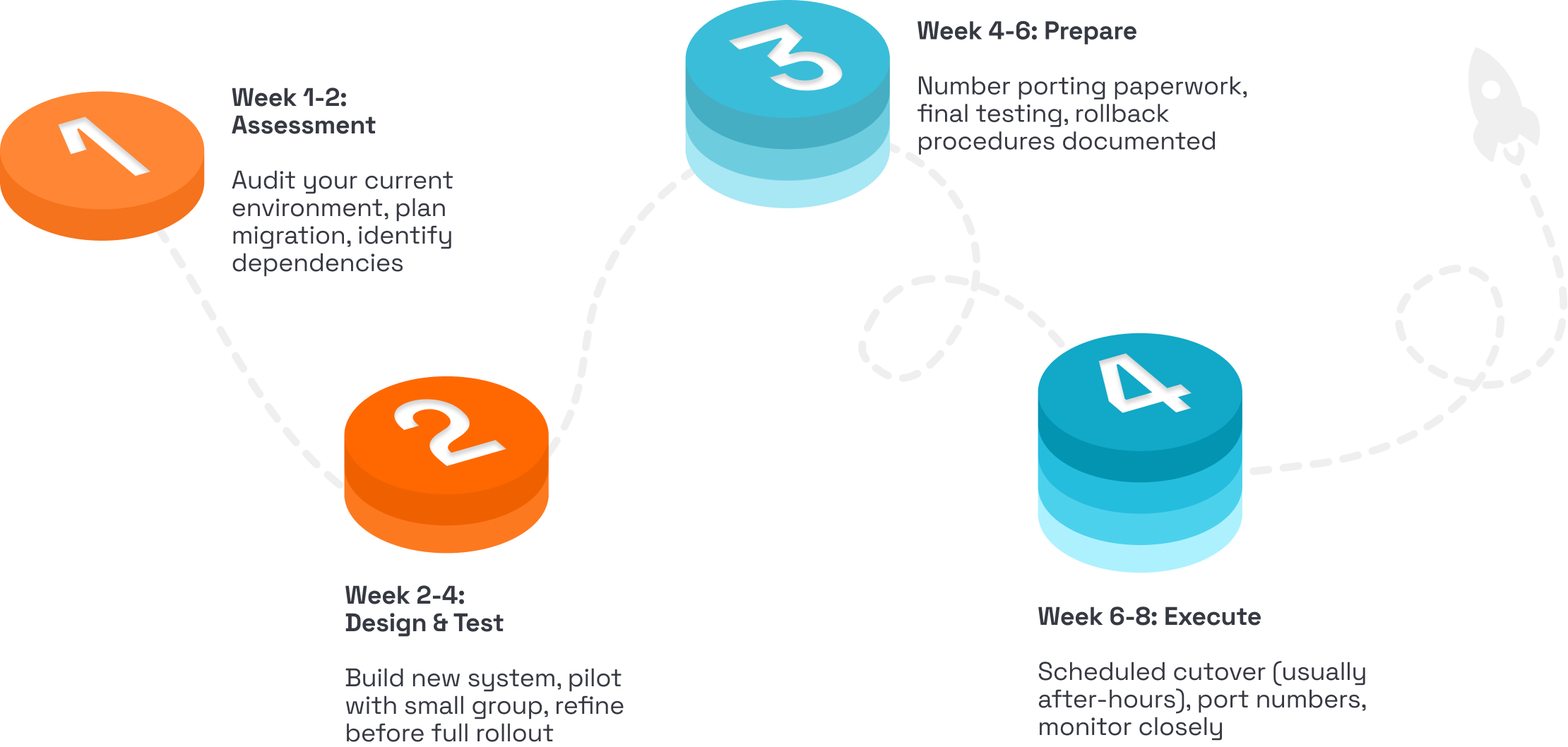

Week 1-2: Assessment
Audit your current environment, plan migration, identify dependencies

Week 2-4: Design & Test
Build new system, pilot with small group, refine before full rollout

Week 4-6: Prepare
Number porting paperwork, final testing, rollback procedures documented

Week 6-8: Execute
Scheduled cutover (usually after-hours), port numbers, monitor closely
Common Questions from Mitel Customers
Find answers to common questions about Techmode’s services and solutions.
Is Mitel actually going out of business?
Mitel emerged from Chapter 11 bankruptcy and continues to operate. However, the restructuring process, combined with end-of-life announcements for products like MiVoice Connect and the sale of their UCaaS business, has created uncertainty for customers. The question isn’t whether Mitel will exist, but whether their platform and support model align with your long-term needs.
Should I wait until my contract expires or switch now?
It depends on several factors: How much time remains on your contract? Are you experiencing significant support issues? Do you need features your current system doesn’t offer? We can help you run a TCO analysis to determine whether early termination fees are worth it or if waiting makes more sense. Take our assessment to get a custom recommendation.
What happens to my phone numbers if I switch?
Number portability is federally regulated and highly reliable. We handle all carrier coordination to port your existing numbers to the new system. The process typically takes 2-4 weeks for paperwork, with the actual cutover happening in under 4 hours. In rare cases where porting has delays, we can forward your old numbers to new ones temporarily so you never miss a call.
How long does migration really take?
Most migrations take 30-90 days from kickoff to complete cutover, depending on complexity. Simple deployments (single location, <100 users, basic features) can be faster. Complex deployments (multiple locations, contact center, extensive integrations) take longer but follow the same structured process. The actual cutover (when numbers port and you switch systems) typically happens in less than 4 hours during a scheduled maintenance window.
What if my Mitel product is discontinued?
If you’re on MiVoice Connect or another EOL product, your options depend on your specific situation. Some customers can migrate to current Mitel platforms, but many require switching providers entirely. The effort involved in moving to a different Mitel product vs. switching to a competitor is often similar—which means it’s worth evaluating all options, not just assuming you must stay within the Mitel ecosystem.
Get Clarity on Your Mitel Situation
Whether you ultimately stay with Mitel, switch to Techmode, or explore other options, understanding your position helps you make better decisions. Our assessment gives you objective analysis without sales pressure.