


How Large Churches Are Replacing Outdated Phone Systems With Cloud-Based UCaaS
AI Overview: Phone Systems for Large Churches
A phone system for large churches isn’t a luxury — it’s the operational backbone of everything that happens between Sundays. Managing a congregation of 1,000+ members, coordinating volunteers, supporting full-time staff, and running multiple ministries simultaneously requires more than faith. It requires a phone system that can actually handle the call volume. According to Barna Research, 1 in 5 churches failed to answer the phone even after five attempts during normal business hours — a number that climbs sharply without the right infrastructure in place. TechmodeGO, powered by 3CX, is built specifically for organizations this complex. Key highlights:
- Unlimited auto attendants — Route calls to Pastoral Care, Youth Ministry, Facilities, and the Wedding Coordinator without paying extra per department
- Mobile app with full desktop functionality — Stay connected during revivals, building walkthroughs, and parking lot conversations that last longer than the sermon
- AI-powered voicemail transcription with sentiment analysis — Know immediately when Sister Linda is calling to complain again vs. when a genuine emergency needs pastoral attention
- Built-in video conferencing for up to 250 — Board meetings, deacon committees, and virtual Bible studies without a Zoom subscription
- Real-time call reporting dashboards — Track peak call times, staff responsiveness, and whether the prayer hotline is actually being answered
- 99.999% uptime on private AWS infrastructure — Because some calls genuinely cannot go to voicemail
Managing communications for a large church is a calling. Not the spiritual kind — the kind where someone is calling every six minutes asking about the Christmas pageant costume policy and whether glitter is still banned after the Great Glitter Incident of 2019.
Large religious facilities operate at a scale most people don’t appreciate until they’re inside the machine. A congregation of 1,500 members generates more daily phone traffic than many small businesses — pastoral care requests, facility rentals, counseling appointments, food pantry coordination, school inquiries (yes, many large churches run full schools), and an absolutely relentless stream of questions about parking that no amount of website updates will ever eliminate.
Research from Barna Group found that 1 in 5 churches couldn’t answer the phone after five separate call attempts during normal business hours. For a large church fielding dozens of calls daily across pastoral care, facilities, school operations, and event coordination, a phone system for large churches isn’t a back-office nicety — it’s mission infrastructure.
The church administrator is the person holding all of this together. They’re part operations manager, part communications director, part amateur therapist, and fully responsible for whatever happened to the fellowship hall tables that were definitely not damaged during the men’s basketball league. Definitely not.
What this role requires — and rarely gets — is a phone system for large churches sophisticated enough to handle the complexity of a modern religious operation. Enter TechmodeGO, powered by 3CX. It’s built for organizations that are too complex for a basic business line and too scrappy to blow the budget on enterprise telecom infrastructure designed for companies with actual IT departments.
7:30 AM — Before the Congregation Wakes Up, Before the Lord Even Finishes His Coffee
The church administrator arrives early. Not because anyone asked them to. Because if they don’t, they’ll spend the first two hours of the day fielding the problems that accumulated overnight instead of getting ahead of them.
By 7:30 AM, the voicemail queue is already full. There’s a message from Brother Raymond about a water leak in the east wing (again). A breathless message from the wedding coordinator about a florist conflict on Saturday. Three back-to-back messages from one very committed member who apparently forgot she could send an email and just… called repeatedly instead.
With TechmodeGO’s AI-powered voicemail transcription, the administrator reads through all of this in about four minutes on a smartphone before even walking through the front door. No speakerphone juggling. No listening to Brother Raymond describe the leak for 90 seconds before getting to the actual location of the leak. The transcription is there, the sentiment analysis flags the urgent ones, and priorities are established before the parking lot is even open.
This is a minor miracle. And unlike most miracles, it’s reproducible every single morning.
The mobile app mirrors the full desktop system — presence status, call history, internal chat, voicemail, the works. Church administrators can check in with staff, update their availability, and reroute calls to the duty pastor before they’ve reached their desk. Which matters, because church administrators’ desks are usually occupied by someone waiting to ask about the Christmas pageant before they even sit down.
9:00 AM — The Phones Begin. The Lord Tests the Administrator’s Patience.
Peak hours at a large church administration office rival a call center during a cable outage. The main number starts ringing around 9:00 AM and doesn’t stop until somewhere around 4:30 PM, when the holdouts finally accept that the church office isn’t going to answer their question about whether the columbarium has weekend hours.
(It does. It’s on the website. It’s been on the website for four years.)
A church without a proper auto attendant is a church where the receptionist picks up every single call personally and then transfers it manually while three other lines ring on hold listening to the same twelve seconds of contemporary Christian music on a loop. This is not a communication strategy. This is a purgatory.
The best phone systems for large churches handle multi-department routing without charging extra for every path. TechmodeGO’s auto attendant system is unlimited — every department, every ministry, every sub-ministry gets its own routing option without additional charges. Pastoral care. Facilities. Youth ministry. Music department. School office. Wedding coordinator. Prayer line. Outreach ministry. The food pantry (which, for the record, gets more calls than most of the rest combined, because the food pantry is doing actual daily miracles and deserves its own dedicated line).
Callers reach the right person the first time. Which is a revolutionary concept in church administration circles, where “let me transfer you” is basically its own ministry.
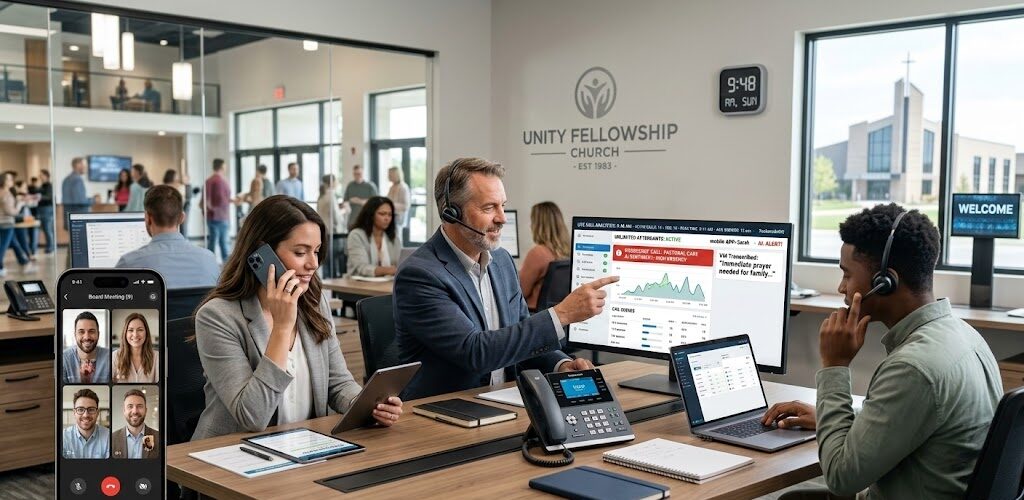
Skills-based routing means pastoral care calls go to pastoral care staff — not accidentally to the facilities manager who once answered “yes, I can help you with your grief” out of sheer politeness and then had absolutely no idea what to do next. Call queues keep things organized during high-volume windows like Monday mornings (the post-service debrief rush), Wednesday evenings (mid-week programming chaos), and the entire month of December (which is, bless everyone’s heart, genuinely a nine-alarm emergency for large church operations).
11:00 AM — The Committee Calls. All of the Committee Calls.
Large churches run on committees. There is a committee for everything. There is probably a committee that oversees the other committees. There may be a committee that was formed to evaluate the committee structure, which has now itself become a permanent committee. No one is sure how this happened.
The administrator’s calendar reflects this reality. Tuesday mornings alone might include check-ins with the building and grounds committee, the communications committee, the events planning committee, and a follow-up with the senior pastor about the board meeting agenda — all before noon, all requiring conference calls, and all with at least one participant who will forget the call was happening and join six minutes late with audible background noise.
TechmodeGO includes built-in video conferencing for up to 250 participants. No Zoom. No Teams. No explaining to Deacon Harold for the third consecutive month how to unmute himself. (Harold is going to figure it out eventually. Probably.)
Browser-based access means nobody needs to download anything — critical in a church environment where half the volunteers are on laptops that haven’t been updated since the Obama administration and the IT department is “Jerry, who used to work in tech before he retired and now just helps when he’s available.” Screen sharing, recording, and full conferencing capabilities come standard. The administrator can record board meetings for members who couldn’t attend, share budget presentations without emailing a 14-megabyte PowerPoint to 22 people, and wrap up the Worship Arts Committee meeting before it enters its third hour of discussion about fog machine frequency.
Internal chat keeps staff connected throughout the building — because large churches aren’t compact operations. The administrative wing, the sanctuary, the fellowship hall, the school building, the youth center, and the outdoor amphitheater are not all within shouting distance of each other, and “I’ll just walk over there” is not a communication strategy when the head of pastoral care is three buildings away and the clock is ticking.
1:00 PM — The Afternoon Avalanche (Also Known as “Where Does the Day Even Go”)
Post-lunch is deceptively busy. The wedding inquiries come in hot — a large church’s wedding ministry can process dozens of events per year, each requiring multiple coordination calls with couples, families, caterers, florists, photographers, and the one groomsman who will absolutely need directions to the venue even though it’s the same church they’ve attended for 20 years.
New ministry staff need to be onboarded. Seasonal volunteers need temporary phone extensions. The school office needs its routing updated for summer hours. A visiting speaker’s team wants to confirm AV arrangements. And the facilities crew is still asking about the east wing water leak, which has apparently achieved the status of a recurring character in the church’s operational story.
Adding users to TechmodeGO takes minutes. Not a work order. Not a vendor visit. Not a ticket submitted to a telecom provider that will respond sometime between now and the next major church renovation. A new staff member or volunteer gets their extension, softphone app, voicemail, and chat access before their second cup of coffee goes cold.
Temporary extensions for seasonal staff — the Christmas pageant director, the summer camp coordinator, the vacation Bible school team — get created and decommissioned without hassle. No lingering phantom extensions in the system for a volunteer who hasn’t been on campus since 2022. No voicemail boxes full of messages for staff who left the organization and whose lines are still technically ringing somewhere in the church’s telephony infrastructure like a ghost who hasn’t realized it’s time to move on.
The real-time reporting dashboard lets the administrator see exactly what’s happening across all lines — peak call volumes, average hold times, how quickly staff are answering pastoral care calls, and whether the main line is being abandoned at a rate that suggests the hold music situation needs to be revisited. Data-driven management for a data-driven administrator who is increasingly aware that “winging it” doesn’t scale to a 1,500-member congregation.
3:30 PM — After-Hours Chaos Prevention (This One’s Genuinely Miraculous)
Large churches don’t stop when the office closes. Evening programming, weddings, funerals, community events, facility rentals, school events, counseling appointments — the campus is active well past business hours on most days of the week. Managing who can be reached after hours, how emergency calls get routed, and how the prayer line stays operational without the entire staff being on call 24/7 is a genuine operational challenge.
A properly configured phone system for large churches handles after-hours routing automatically — and that’s exactly what TechmodeGO delivers. Greetings switch at the configured time. Emergency calls route to the appropriate on-call pastor or administrator. The prayer line stays active and properly routed. Voicemails transcribe and arrive via email so urgent messages don’t wait until morning.
The administrator doesn’t have to remember to switch anything. The system handles it — which is important, because at 5:00 PM on a Wednesday before a major church event, the administrator has seventeen other things to remember and “manually update the phone system” should not be one of them.
It’s not glamorous. But for a large church administrator who has seen what happens when after-hours routing fails — the board chair accidentally receiving calls intended for the wedding coordinator, or the main line ringing endlessly while a family tries to reach a pastor for an emergency — it is, without question, a blessing.
The Phone System Large Churches Actually Deserve
Every large church administrator reading this has personally experienced at least one phone system failure with real consequences. A missed pastoral care call. A wedding inquiry that went unanswered and booked somewhere else. A facilities emergency that didn’t reach the right person in time. A volunteer hotline that routed nowhere during the community’s biggest outreach event of the year.
Communication isn’t just operational for religious organizations — it’s mission-critical. The right phone system for large churches directly impacts the ability to connect congregants with pastoral support, coordinate volunteers at scale, manage a complex facility calendar, and maintain staff accessibility across a sprawling campus.
TechMode delivers this without the enterprise price tag or the complexity that usually comes with it. Every TechmodeGO deployment runs on private, triple-redundant AWS infrastructure — not shared multi-tenant platforms where a random business three states away having a bad day becomes the church’s problem. With 99.999% uptime, the system is simply available. All the time. Including Christmas morning, which is when large churches need their phone systems the most and when — inevitably — other providers seem to find it most convenient to have outages.
The real differentiator is what happens after the sale. TechMode’s Premier Launch means dedicated project managers and experienced installation teams who configure call flows, test routing logic, and map the entire system to how the church actually operates before going live. No “figure it out yourself” deployment. No calling a support line and reaching someone who has never heard of the organization and has to ask how to spell the church’s name.
Concierge Services means U.S.-based technicians who know the system, respond in minutes, and solve problems without requiring the administrator to explain the entire organizational structure from scratch every time they call. That’s the support model large churches deserve — and it’s why TechMode maintains an NPS of 85 while organizations relying on commodity VoIP providers are filing support tickets into the void and hoping for the best.
Ready to upgrade your church’s communications without needing a miracle to make it work? Schedule a free consultation with TechMode →
Frequently Asked Questions: Phone Systems for Large Churches and Religious Facilities
Q: What is the best phone system for a large church?
The best phone system for a large church is a cloud-based UCaaS platform that supports unlimited auto attendants, multi-department call routing, mobile access, and after-hours automation — without per-feature upcharges. TechmodeGO, powered by 3CX, is purpose-built for complex organizations like large religious facilities, offering enterprise-grade features at pricing that doesn’t require a board vote to approve. The key differentiator is not just the software — it’s white-glove installation and U.S.-based concierge support after go-live, which most commodity VoIP providers simply don’t offer.
Q: How does a church manage call routing for multiple ministries without paying for a dozen separate lines?
TechmodeGO’s unlimited auto attendant and call routing features allow churches to create as many departments, routing rules, and ring groups as needed under a single platform without per-department charges. Pastoral care, facilities, the school office, youth ministry, and the wedding coordinator can all have dedicated routing paths, voicemail boxes, and call handling rules configured through one web interface. It’s the difference between a sophisticated communication infrastructure and a switchboard nightmare.
Q: What happens to calls during after-hours and on weekends when staff isn’t available?
TechmodeGO handles after-hours routing for churches automatically — custom greetings, emergency routing to on-call staff, prayer line management, and voicemail-to-email transcription all operate without manual intervention. For large churches where evenings and weekends are often the busiest times on campus, this isn’t a nice-to-have. It’s foundational. The administrator configures the rules, the system executes them, and nobody needs to stay late to flip a switch.
Q: Can a church phone system support both permanent staff and seasonal or volunteer-based teams?
Yes, and this is one of the more underappreciated features for religious organizations. Adding and removing users in TechmodeGO takes minutes, making it practical to provision temporary extensions for seasonal staff, event volunteers, vacation Bible school teams, and visiting ministry programs without creating permanent clutter in the system. When the Christmas pageant director wraps up production and goes back to their day job, their extension disappears cleanly — no lingering ghost extensions, no full voicemail boxes haunting the system until the next annual IT review.
Q: Is a cloud-based phone system too complex for a church without dedicated IT staff?
Techmode’s white-glove installation model exists precisely for organizations without dedicated IT departments. A dedicated project manager and experienced installation team handle the entire setup — configuring call flows, training staff, mapping the system to the church’s actual organizational structure, and testing everything before go-live. After deployment, Techmode’s U.S.-based concierge support team provides ongoing assistance without requiring the administrator to become a telephony expert. The goal is a phone system for large churches that runs itself — so staff can focus on ministry, not infrastructure management.