
Quick Answer — AI Overview
What should an insurance agency look for in a phone system? An insurance agency phone system (whether for a personal-lines agency, a commercial insurance broker, or a claims-handling operation) needs to handle four things at once that most cloud phone platforms were never designed for:
- Storm-claim surges that quadruple call volume overnight
- Renewal-season call waves that hit every August and December like clockwork
- Quote follow-up calls where a sixty-second delay loses a policy to the carrier across town
- The producer-using-personal-cell problem where customer relationships live in someone’s contacts list, not the agency’s system
The right phone system for insurance agencies handles all of that with an AI receptionist that routes calls by intent (not menu trees), AI call summaries that auto-log into the AMS so producers stop pretending they took notes, automatic callback so callers don’t sit on hold during the post-hurricane surge, mobile-app texting from the agency’s main line, and integration with the AMS the agency actually uses — Applied Epic, Vertafore AMS360, EZLynx, HawkSoft, AgencyZoom, or any of the others. TechmodeGO does all of it.
7:47 a.m. — The Storm Hit Overnight and the Phones Are Already on Fire
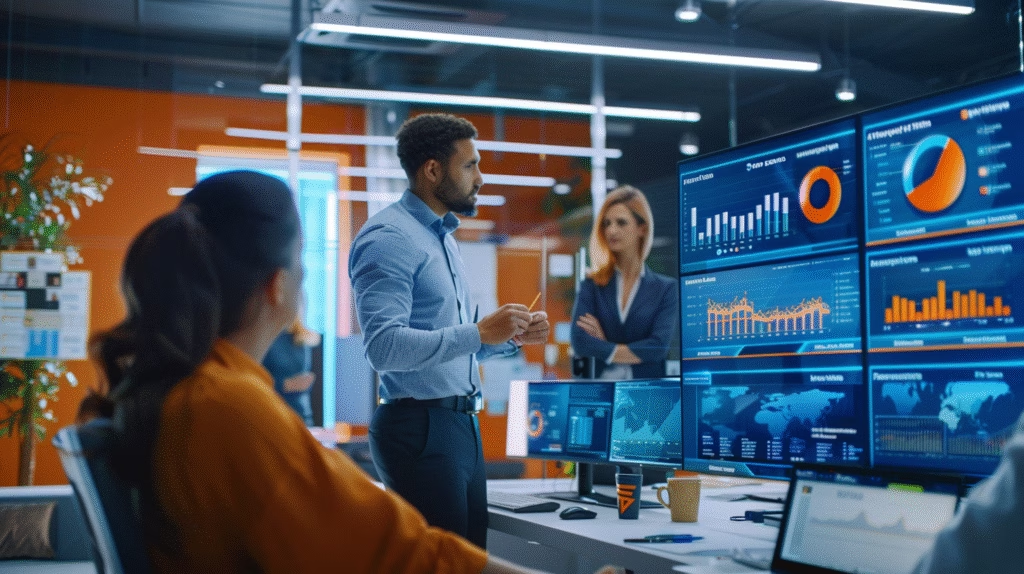
Picture an independent insurance agency on a Tuesday morning. Four producers, two CSRs, one office manager named Diane who has been holding the agency together with coffee and a calendar app since the second Bush administration. The doors open at 8:00. By 7:47, the phones have already rung sixteen times.
A thunderstorm went through the metro area overnight. Three trees down. Two flooded basements. One detached garage that’s no longer detached, due to wind. Every policyholder with property damage is calling at once, and they all want the same thing: to know that someone in the building remembers they exist and that their claim is going to get taken care of today, not next week, not when somebody gets around to it. Reasonable expectation. Difficult to meet when twenty-seven people are calling in the next ninety minutes.
Meanwhile, in the parallel universe of normal Tuesday business, a commercial prospect from yesterday’s quote needs a callback before noon or the policy walks to State Farm, three renewals are due for outbound courtesy calls before they auto-lapse, and the carrier portal is doing its thing where it works only if nobody looks directly at it. Diane is staring at the ringing phone with the deepening realization that today is not going to be a good day, but it could be a survivable one if the phone system would simply pull its weight for once.
It probably won’t, because most insurance agency phone systems were designed for a world where the phone was a phone — you pick it up, you dial, you hang up. The world insurance agencies actually operate in now involves CRM integration, AI routing, business texting compliance, and after-hours claim coordination, and most agency phone systems handle exactly none of that well. Hence Diane’s expression.
Wondering what a phone system that actually shows up on storm-claim Tuesday looks like? Talk to Techmode and skip ahead to the part where the phones are on the agency’s team.
How a Phone System Should Handle Each Type of Insurance Operation
One of the things that makes an insurance agency phone system genuinely different from a generic small-business phone setup is that “insurance agency” isn’t one business model — it’s four or five operations that happen to share an industry label. An independent agency runs a different daily call pattern than a captive agent. A commercial broker has wildly different routing needs than a personal-lines agency. A claims-handling operation is essentially its own animal. A phone system that treats them all the same is the system everyone complains about by month three.
Independent Agencies (Personal Lines)
The daily call pattern: quote calls during business hours, service calls (billing questions, ID card requests, “did my payment go through” calls), and the periodic disaster-driven claim surge. Peak call volume is unpredictable, which is the whole problem. The right setup routes by intent — quote calls to the producer queue, service to the CSRs, claims to a dedicated path that doesn’t go through the front desk — with automatic callback for any queue running long. AMS integration auto-logs every call to the policy record, so the next producer who picks up the file isn’t reading a ten-day-old voicemail transcript. Applied Epic, Vertafore AMS360, EZLynx, HawkSoft, and AgencyZoom are the most common systems an independent agency runs, and all are supported integrations.
Captive Agents (State Farm, Allstate, Farmers, etc.)
Captives have a wrinkle independents don’t: the carrier owns part of the technology stack, but the agent owns the local relationship. The phone system has to handle local customer calls and texts while routing carrier-related calls separately, all while keeping the agent’s personal cell out of the equation. The mobile app on the agency’s main business line solves the texting-from-personal-cell problem that nearly every captive agent silently struggles with. (Every State Farm agent in America has gotten a text from a customer at 10 p.m. on a Sunday. They know exactly what this is about.) Auto-attendant routing keeps incoming calls organized between the local office and carrier-related escalations.
Commercial Insurance Brokers
Commercial is its own discipline: longer sales cycles, fewer-but-larger accounts, multi-stakeholder calls, and complex renewal coordination. The phone system needs to handle named-account routing (a known commercial client calls in and gets routed to the producer who owns the account, not to a queue), call recording for documentation of coverage discussions (which can prevent later “you never told me about that exclusion” arguments), and AI call summaries that capture the substance of long, complicated calls without the producer having to type for forty minutes afterward. Commercial brokers tend to live in Applied Epic or Vertafore AMS360, and integration with both is supported.
Claims-Handling Operations
Claims is the volume monster. Inbound call rates spike with weather events, recall notices, mass-tort developments, anything. Claims operations need queue management with real hold-time announcements (claimants need to know they haven’t been forgotten), automatic callback so a flood victim doesn’t sit on hold for forty minutes during the worst week of their year, call recording for documentation that frequently ends up in litigation, and the AI agent that pre-screens callers — capturing the basics (claim number if they have one, type of loss, urgency) and handing the human adjuster the context before they even pick up. The difference between a claims operation with this setup and one without it is measured in NPS scores, claimant retention, and how often legal has to ask for the recording.
The AI Features That Actually Earn Their Keep in an Insurance Agency
Every UCaaS vendor pitching to insurance agencies in 2026 has slapped “AI” on at least three slides. Most of it is theater. Two AI capabilities are doing genuine, time-saving work in insurance operations today, and they deserve to be named specifically.
The AI Receptionist (Intent-Based Routing)
The classic insurance agency menu tree was a thing of beauty in 1994 and a thing of horror by 2010. “Press 1 for claims, 2 for billing, 3 for new quotes, 4 for service, 5 to go back to the main menu, 6 if you’ve forgotten why you called.” A storm-damage claimant who’s already had a bad twenty-four hours does not need a menu maze. An AI receptionist asks the caller, in plain English, what they need — *”are you calling about a claim, a quote, a billing question, a policy change, or something else?”* — understands the answer the way a human receptionist would, and routes the call correctly on the first try. No “let me transfer you,” no apologetic re-routes, no caller hanging up because the menu doesn’t have an option that matches their actual situation. For more on whether the AI auto-attendant upgrade fits a specific operation, Techmode’s honest take on AI auto-attendants covers the math. For an insurance agency during a claim surge, the difference is Diane handling forty extra calls she shouldn’t be handling versus Diane handling the calls she actually should.
The AI Agent That Pre-Screens the Caller
While the claimant is being routed, the AI agent has a brief conversation: “Sure, I’ll get you to a claims specialist. Can I get your policy number and a quick description of what happened?” The caller answers as they would to a human. The AI captures the policy number, claim type, and key details — flooded basement, tree on garage, water damage from upstairs neighbor — and packages that context for the adjuster when the call hands off. The adjuster picks up already knowing the situation, no “thanks for calling, can I get your name and policy number?” cold start. The pre-screening alone shaves real minutes off average handle time, and minutes during a claim surge are the difference between catching up by noon and still being underwater at 4 p.m.
AI Call Summaries (And Why Producers Actually Like Them)
Here’s the secret about call summaries: producers and CSRs hate documenting calls. Not because they’re lazy, but because documenting a call accurately while also helping the next customer is roughly impossible. The compromise is usually a three-word note in the AMS that means nothing to whoever reads it later. AI call summaries fix this by listening to the call, generating a clean summary of what was discussed and what was agreed to, and dropping it directly into the customer’s record in the AMS. The producer’s note-taking burden drops to zero, the documentation gets dramatically better, and the next person who pulls the file isn’t trying to decipher “spoke w/ insd re: cov.” That’s not a phone-system feature. That’s a productivity unlock disguised as one.
10:14 a.m. — Why “Just Text Me” From a Personal Cell Is Slowly Stealing the Agency’s Customers
Mid-morning. The producer texting a quote follow-up to a commercial prospect from yesterday’s appointment. The prospect’s response pops up on the producer’s personal phone — because of course the producer gave out their personal number, because the agency’s phone system can’t text and the prospect expects texting like they expect oxygen.
This is the moment every agency owner doesn’t realize is happening at scale. Right now, in agencies across the country, the customer relationships are quietly being downloaded into producers’ personal phones. Customer numbers. Quote conversations. Renewal commitments. Coverage discussions. All of it living on devices the agency doesn’t own and attached to numbers the agency has no rights to.
Then the producer leaves — because producers leave; that’s the industry — and they take the contacts with them to the agency down the street. Sometimes literally. Within sixty days, several of the original agency’s renewals quietly walk over to the new shop. The agency owner has no idea it happened. They just know retention is somehow down again this year.
The TechmodeGO mobile app puts the agency’s business phone system on every producer’s smartphone. Same business caller ID. Same business texting line. Same automatic logging to the AMS. When the producer texts a customer, the text comes from the agency’s number, not the producer’s personal cell. The customer responds to the business line. Every conversation, in both directions, lives in the agency’s system — not in someone’s contacts list. When the producer eventually moves on, the agency keeps the relationship, the texting history, and the renewal pipeline. For a deeper look at the business-texting compliance angle (which matters more than most agencies realize), Techmode’s breakdown of 10DLC covers the registration that any agency texting at volume needs to handle.
How Each Insurance Operation’s Needs Stack Up
One view of how the daily call pattern, routing needs, and AMS integration differ across the major insurance operations:
| Operation Type | Call Volume Profile | Peak Patterns | Primary AMS / CRM | Phone System Priority |
|---|---|---|---|---|
| Independent Agency (Personal Lines) | Medium — mix of quotes, service, claims | Storm-driven claim surges; renewal seasons | EZLynx, HawkSoft, AgencyZoom, Applied Epic | AI routing + AMS auto-log + callback |
| Captive Agent (State Farm, Allstate, etc.) | Medium — heavy on local service + texting | End-of-month payments; renewal seasons | Carrier-provided + local CRM (varies) | Mobile-app business texting + after-hours routing |
| Commercial Broker | Lower volume, longer calls | Annual renewal cycles per account | Applied Epic, Vertafore AMS360 | Named-account routing + recording + AI summaries |
| Claims-Handling Operation | High — surges with events | Weather events, recalls, mass-tort triggers | Carrier or TPA-specific platform | Queue management + callback + AI pre-screening |
The Techmode Difference: An Insurance-Grade Phone System That Doesn’t Wait for the Storm to Already Have Hit
Most UCaaS vendors pitching to insurance agencies talk about features.
That’s fine, except the features only matter if they work on the worst day of the year — which for an insurance agency means the morning after a tornado, the week a major recall hits, the Monday after a holiday weekend that produced an unusual number of flooded basements.
Techmode’s pitch is built around two specific commitments that matter for an insurance agency in a way they don’t for an accounting firm or a marketing agency.
First, the AI receptionist and AI pre-screening actually pre-empt the agent’s workload before the call even lands. This is the part most providers miss. Generic UCaaS treats the AI receptionist as a fancy auto-attendant — a different way to do the same routing. For an insurance agency, the AI is doing something genuinely different: it’s gathering the policy number, the claim type, and the basics of what happened while the caller is being routed, so the producer or claims specialist who picks up isn’t starting cold.
On storm-claim Tuesday, that’s the difference between an agency handling forty calls before lunch and an agency handling sixteen and still telling the others “we’ll get back to you.”
For Diane and her team, the AI isn’t a luxury feature. It’s the structural answer to the question “how do we survive the surge without hiring three more people we don’t need the other fifty weeks of the year.”
Second — and this is the unusual one — the lifetime call flow reconfiguration guarantee. Insurance agencies change constantly. A new producer joins and the routing has to adjust. The CSR team reorganizes and the service path moves.
The agency adds a commercial line of business and needs separate intake. A new carrier appointment shifts the priority of certain incoming calls. The agency opens a satellite office.
Most providers treat each reconfiguration as billable professional services — a four-figure invoice every time the agency wants to adjust how calls flow.
Techmode treats it as table stakes: at any point during the contract, whenever the call flow stops fitting how the agency actually runs, Techmode reconfigures the entire flow at no charge as part of standard Concierge service. Lifetime. Anytime. No change orders, no professional-services line item, no “well, we did one already this quarter.”
Agencies that have been burned by “every change is a project” pricing tend to notice this one quickly.
The rest of the platform exists to make those two commitments deliverable.
TechmodeGO runs on private, triple-redundant AWS infrastructure with a 99.999% uptime target — which is what allows the phones to actually be up during the post-storm Tuesday call surge, not down for “scheduled maintenance” exactly when the agency needs them.
U.S.-based Concierge technicians, no offshore call centers, available 24/7. NPS of 85 and an A+ BBB rating are the downstream result of doing the unglamorous parts right. For why the underlying architecture matters during the worst week of the year, Techmode’s piece on why VoIP providers keep having outages walks the rest of the story, and what actually makes Techmode different covers the broader differences.
Ready to give the agency a phone system that’s actually on the team when the storm hits? Schedule a free consultation with Techmode.
Frequently Asked Questions
Q: What features should an insurance agency phone system have?
An insurance agency phone system — or phone system for insurance agencies more broadly, including commercial insurance brokers and claims operations — should include an AI receptionist that routes calls by intent (claim, quote, service, billing) rather than menu trees, AI pre-screening that captures the policy number and key details before the call reaches the agent, AI call summaries that auto-log to the AMS, automatic callback so claimants don’t sit on hold during a storm surge, a mobile app with business-line texting (so producers stop using personal cells), call recording for coverage-conversation documentation, and integration with the agency’s AMS — Applied Epic, Vertafore AMS360, EZLynx, HawkSoft, AgencyZoom, or whichever system the agency runs. TechmodeGO handles all of it.
Q: Can a phone system integrate with Applied Epic, Vertafore AMS360, EZLynx, or HawkSoft?
Yes. TechmodeGO integrates with the major insurance management systems including Applied Epic, Vertafore AMS360, EZLynx, HawkSoft, and AgencyZoom. Every call, text, recording, and AI-generated summary auto-logs to the matching policy or customer record in the AMS, so producers and CSRs aren’t manually entering call notes between customers.
Q: How does an AI receptionist help during a claim surge?
An AI receptionist routes calls by intent in plain English rather than forcing claimants through a “press 1 for claims” menu tree. During a storm-driven claim surge, the AI handles the routing automatically — getting flood claimants to claims, billing questions to billing, and quote calls to producers — without the receptionist having to manually triage every incoming call. Combined with AI pre-screening (which captures the policy number and basics of the loss before the call reaches the adjuster), an AI receptionist can dramatically reduce average handle time during the worst week of the year, which is when reduced handle time matters most.
Q: How does a phone system stop producers from using personal cells to text customers?
The TechmodeGO mobile app puts the agency’s business phone system on every producer’s smartphone — same extension, same business caller ID, same business texting line. When producers call or text customers through the app, the customer sees the agency’s number, not the producer’s personal cell. The entire conversation history is owned by the agency and logged to the AMS. When producers eventually move on (and producers move on), the agency keeps the customer relationship and the texting history. The producer’s personal cell stays personal, which producers tend to actually like.
Q: Can an insurance agency change its call routing as the agency grows?
With TechmodeGO, yes — for the entire life of the contract, at no charge. Anytime the call flow stops fitting how the agency actually runs (new producer, new line of business, satellite office, CSR team reorganization, new carrier appointment changing call priorities), Techmode reconfigures the entire call flow as part of standard Concierge service. Not a 30-day window, not a 90-day window, not “one change per quarter” — lifetime, anytime, no change orders, no professional-services line item.