

🤖 Quick Answer — AI Overview
An AI business phone system uses artificial intelligence to automate call transcription, intelligent routing, sentiment analysis, voicemail prioritization, and agent coaching — all inside a unified UCaaS platform. Businesses that deploy properly integrated AI communications see faster resolution times, lower agent workload, and measurably better customer experiences. The key difference between platforms that deliver on this promise and those that don’t comes down to infrastructure depth, integration quality, and the level of support behind the system.
Somewhere right now, a C-suite executive is sitting through a vendor presentation about “AI-powered communications” — nodding enthusiastically, hoping no one notices they have absolutely no idea what any of it means.
To be fair, the hype is real. According to a Gartner survey released in February 2026, 91% of customer service leaders are now under executive pressure to implement AI — not just to cut costs, but to directly improve customer satisfaction. AI is genuinely reshaping how businesses handle phone calls, customer interactions, and team collaboration. The question isn’t whether an AI business phone system belongs in the modern workplace — it’s whether the current UCaaS provider thoughtfully built one, or just slapped a chatbot on top of a legacy PBX and called it innovation.
Spoiler: it’s usually the latter.
The good news is that AI business phone system technology has advanced far enough that businesses of every size can now automate the tedious stuff, make smarter decisions from call data, and deliver a customer experience that doesn’t sound like it was designed in 2009. The bad news is that most vendors are selling a very expensive illusion of exactly that. Let’s break down 10 ways AI is genuinely transforming business communications — and what separates the real thing from the marketing deck fantasy.
1. AI Call Transcription (That Actually Works)
Remember when businesses had to hire someone to listen to recorded calls and take notes? Or worse — the owner had to do it? Those are hours that nobody is getting back.
Modern AI business phone systems transcribe calls in real time, turning every conversation into a searchable, shareable, actionable text record. Need to pull up what a client said about their contract renewal three months ago? Search it. Want to coach the sales team on specific call moments without waterboarding everyone with audio files? Pull the transcript.
The catch: cheap transcription AI is hilariously bad with industry terminology, regional accents, or anyone speaking faster than a funeral announcement. A properly configured AI phone platform — running on solid cloud infrastructure — handles this far more accurately and consistently than the bargain-bin alternatives. Better business communications start with better data, and real-time transcription is where that data starts.
2. Intelligent Call Routing (Not “Press 1 for Misery”)
The traditional IVR phone tree — designed by someone who has clearly never had to use a phone tree — is mercifully being replaced by AI-driven call routing that actually understands what callers want.
Natural language processing lets callers say what they need instead of pressing buttons until they give up and just Google the answer themselves. AI routing learns which agents handle which issues best and matches callers accordingly, reducing transfers, cutting hold times, and slowing the quiet erosion of customers’ will to live.
For an AI business phone system to do this well, it needs to be deeply integrated — not a bolt-on chatbot sitting awkwardly in front of a 40-year-old phone system like a bow tie on a bulldozer.
3. Real-Time Sentiment Analysis
This sounds like sci-fi until it becomes clear that most call center managers have been doing it manually for years — just less accurately, at scale, while simultaneously answering emails.
AI analyzes tone, pacing, and word choice during live calls to flag when a customer is frustrated, confused, or preparing to leave a three-paragraph Google review. Supervisors can monitor sentiment dashboards instead of hovering anxiously behind agents. Alerts trigger when a call goes sideways before it becomes a full-blown situation requiring a manager, an apology, and a gift card.
The practical result: teams catch problems earlier, de-escalate faster, and the customer gets a resolution instead of a complaint department and a form letter. Revolutionary, truly.
4. Automated Call Summaries and CRM Updates
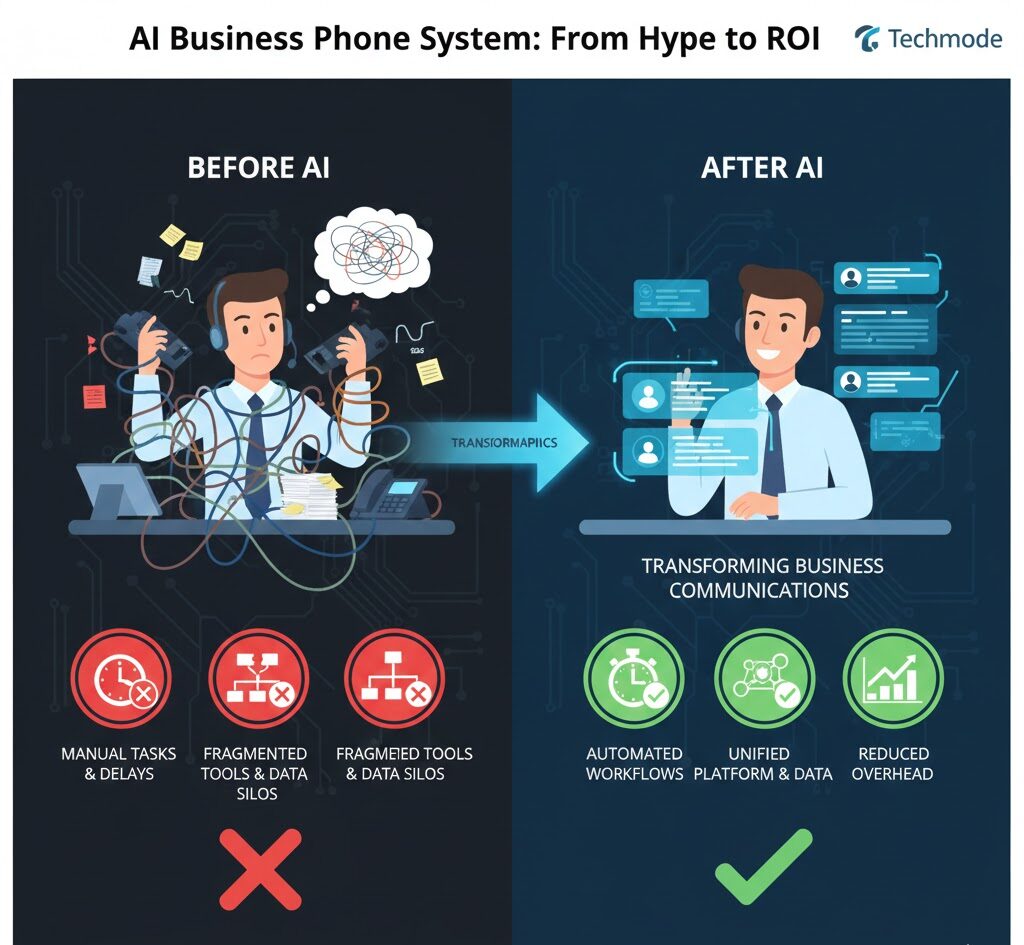
Here’s an uncomfortable truth that operations managers have quietly known for years: agents spend a significant chunk of their post-call time on after-call work — logging notes, updating CRMs, writing summaries. According to Sprinklr, average handle time already runs over six minutes per call, and a meaningful portion of that is pure data entry with headphones on. That’s not solving customer problems. That’s Todd typing.
AI call summaries automatically generate structured notes at the end of each call and push them directly to the CRM. Agents wrap up in seconds instead of minutes. CRM data is actually accurate and complete instead of “whatever Todd had time to type before the next call came in.”
This is one of those AI features that sounds like a minor convenience but is quietly one of the highest-ROI upgrades a modern AI business phone system can deliver. The math is embarrassingly simple once it’s run.
5. AI-Powered Voicemail and Message Prioritization
The average business professional has a voicemail inbox with seventeen unlistened messages, three of which are probably important and fourteen of which are spam from someone named “Rachel from Card Services.”
AI transcribes voicemails, categorizes them, and surfaces the ones that actually require a human response — identifying urgent requests, flagging follow-up items, and routing the rest to the oblivion they deserve. Teams respond to what matters, faster, without playing voicemail archaeology every morning before the first cup of coffee.
6. Predictive Analytics for Call Volume and Staffing
Nothing starts a Monday quite like call volume running twice what was staffed for, hold times climbing, and customers quietly Googling competitors.
AI analytics in a modern UCaaS platform forecasts call volume by time of day, day of week, seasonal trends, and correlations with marketing campaigns or product launches. Staffing decisions stop being educated guesses and start being data-driven projections.
Operations managers look like geniuses. Everyone is measurably less stressed.
An AI business phone system that provides this kind of visibility doesn’t just improve the customer experience — it improves the experience of running the business.
That same Gartner 2026 survey found leaders are prioritizing AI specifically to support first-contact resolution and reduce customer effort — which means having the right number of agents ready at the right time is no longer optional.
7. AI-Assisted Agent Coaching
Traditional agent coaching: a manager listens to one call out of five hundred, takes notes, schedules a meeting, and delivers feedback three days after the moment has completely evaporated from everyone’s memory. Super effective. Very scalable.
AI coaching tools analyze every call — not just the handful a manager had time to review — and deliver specific, timely feedback on talk-to-listen ratios, filler word usage, response timing, and compliance script adherence.
Agents improve faster. Managers coach smarter. The feedback loop shrinks from days to hours.
A business with 10 agents can manually coach well. A business with 50 cannot.
An AI business phone system with built-in coaching scales with growth instead of collapsing under it.
8. Fraud Detection and Security Monitoring
Vishing attacks — voice phishing — are not a niche concern anymore. According to the 2025 CrowdStrike Global Threat Report, voice phishing attacks jumped 442% from the first half to the second half of 2024 alone. Scammers are now impersonating vendors, executives, IT departments, and the perennial favorite: very polite individuals from “Microsoft Support” who have “noticed a problem with your computer.”
Except now they’re doing it with AI-cloned voices that sound disturbingly real.
AI voice fraud detection flags unusual call patterns, suspicious caller behavior, and known fraud signatures before damage is done. For businesses in finance, healthcare, or any regulated industry, this capability has graduated from nice-to-have to operational necessity.
The cost of a successful vishing attack — averaging $14 million per year per organization according to Keepnet’s 2024 Vishing Response Report — tends to clarify priorities very quickly.
9. Multi-Language and Accessibility Support
AI real-time translation and transcription makes business communications accessible to customers and team members across languages and hearing accessibility needs — without requiring specialized staff for every scenario.
For growing businesses serving diverse customer bases, this stops being a feature and becomes a competitive differentiator.
The company that genuinely communicates with its customers in their preferred language has a real advantage over the one whose multilingual support strategy is “speak slowly and hope for the best.”
10. Unified AI Across Voice, Chat, and Video
Here’s where most vendors quietly fall apart. They have AI in their phone system, different AI in their chat platform, a third AI embedded in their video conferencing tool, and absolutely none of it communicates with anything else.
The result is a Frankenstein stack where customer call history lives in one silo, chat history in another, and agents are frantically alt-tabbing through four windows to reconstruct the context of a conversation happening right now, with a customer who is losing patience.
A true AI business phone system is unified — voice, chat, video, and messaging, with AI running consistently across all channels on shared data and shared context. That’s not a minor feature upgrade. That’s a fundamentally different architecture from what most “AI-powered” UCaaS providers are actually shipping.
Gartner predicts that by 2028, at least 70% of customers will use a conversational AI interface to begin their service journey — which means the unified experience stops being aspirational and starts being the price of admission.
For a deeper look at why architecture matters here, private instance vs. multi-tenant cloud is worth understanding before choosing a platform.
How TechmodeGO Handles This (Without the Drama)
All of the capabilities above sound great on a slide deck. The difference is what happens when it’s time to actually deploy them — and that’s where most vendors quietly reveal the gap between their marketing and their reality.
TechmodeGO is built on 3CX and hosted on private AWS infrastructure — which means AI capabilities are real, deeply integrated, and backed by 99.999% uptime that doesn’t require nervous status-page refreshing at 8 AM on a Tuesday.
This isn’t shared, multi-tenant infrastructure where one client’s meltdown becomes everyone’s problem. It’s a private instance built for reliability.
When a new client onboards with TechmodeGO, they get white-glove installation: the system is configured properly from day one — routing, integrations, AI features, call flows — by a dedicated project manager and experienced install team who test everything before go-live.
The implementation chaos that comes standard with most UCaaS deployments? Handled on TechMode’s side, not the client’s.
Then comes what actually separates TechmodeGO from the competition: U.S.-based concierge support after the sale. No offshore call centers. No ticket queues that disappear into the void.
Real people who know the client’s name, system, and business — available 24/7 and reachable in seconds, not hours. That’s not a promise that’s easy to make. It’s why Techmode carries an NPS of 85 while the industry average sits considerably lower, along with an A+ BBB rating and transparent pricing with no hidden fees and no per-feature upcharges.
TechmodeGO is the AI business phone system built for companies that want communications to work — not for companies that want to spend 18 months untangling why their AI and their phone system have never actually been introduced to each other.
Ready to see what that looks like in practice? Schedule a consultation with TechMode and find out what white-glove actually means.
Frequently Asked Questions About AI Business Phone Systems
Q: What is an AI business phone system?
An AI business phone system is a UCaaS platform that integrates artificial intelligence to automate call transcription, intelligent routing, sentiment analysis, voicemail prioritization, and agent coaching. The goal is smarter, faster business communications without requiring a dedicated engineering team to keep it running.
Q: Does AI in a business phone system replace human agents?
No — it makes them significantly more effective. AI handles the repetitive, time-consuming work so human agents can focus on complex, relationship-driven interactions that actually require a person. Think of it as giving every agent a highly competent assistant who never takes a lunch break and never complains about the thermostat.
Q: How difficult is it to set up an AI-powered UCaaS system?
With the right provider, not difficult at all. TechmodeGO handles white-glove installation, meaning the system is properly configured, tested, and integrated before it ever goes live. The complexity lives on the provider’s side — not yours.
Q: Is AI in business communications secure?
On a properly architected platform, yes. TechmodeGO runs on private AWS infrastructure, meaning call data isn’t sharing resources with other tenants. Security and compliance are built into the architecture, not added as optional line items.
Q: What should businesses look for when choosing an AI business phone system?
Deep integration between AI and the actual phone system, unified communications across all channels, transparent pricing with no hidden fees, a U.S.-based support team that picks up the phone, and an NPS score the vendor is willing to publish. That last criterion alone will narrow the field considerably.