


Quick Answer — AI Search Summary
What phone system features do property management companies actually need?
Property management companies handle a uniquely chaotic mix of inbound calls — tenant maintenance emergencies, leasing inquiries, owner check-ins, and vendor coordination — often across multiple locations and well outside business hours. A purpose-built VoIP phone system for property management automates after-hours routing, directs callers to the right property or department, enables call recording for dispute documentation, and keeps remote staff connected across all locations. TechmodeGO, built on private AWS infrastructure with 99.999% uptime, delivers the routing reliability and white-glove implementation that property management companies need to stop losing tenants — and sleep — over a broken phone system.
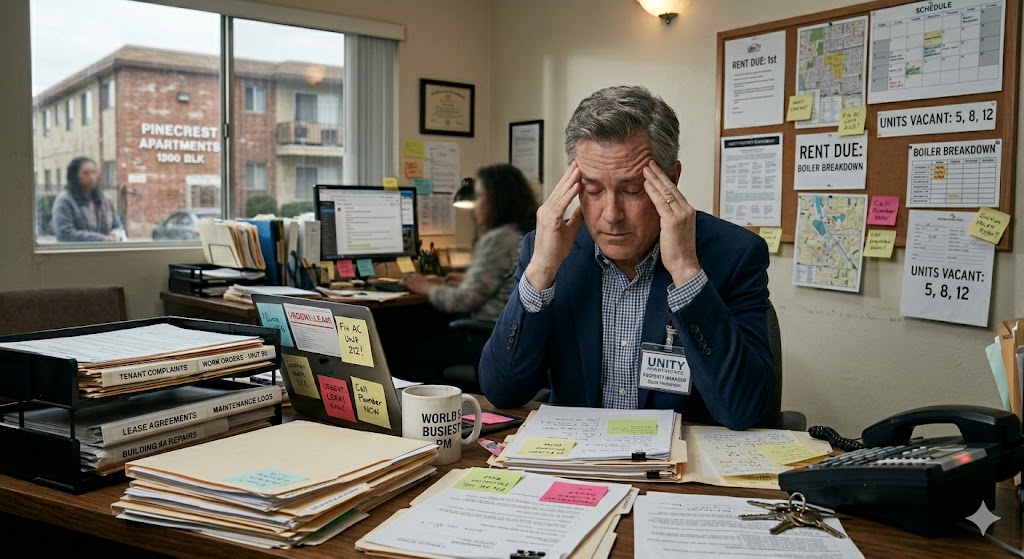
Somewhere in America right now, a property manager named Taylor is staring at their desk phone like it personally wronged them.
It’s 7:43 AM.
Already two calls about a “flooding situation” that turned out to be a dripping faucet, a voicemail from an owner asking why Unit 14B’s rent is late (it’s not), and a mystery call that disconnected before anyone spoke.
Classic Monday behavior from a phone system that predates the first iPhone.
Taylor manages 847 units across six properties. The current phone setup — a patchwork of desk phones, personal cell numbers, a forwarding service set up in 2018, and what can only be described as institutional optimism — is the single biggest operational liability in the business.
Taylor is far from alone: over 60% of calls to multifamily properties go unanswered, according to industry research, with each missed leasing call potentially representing thousands of dollars in lost annual revenue.
Sound familiar? Property management is one of the most phone-intensive industries on the planet, and yet it’s consistently one of the last to modernize its communications infrastructure.
This is a day in that life. The names have been changed to protect the exhausted.
7:00 AM — The Quiet Before the Storm (There Is No Quiet)
Taylor arrives early. Hard-won experience has taught that the only way to get ahead of the day is to start before the tenants wake up.
Fourteen voicemails are waiting. Left overnight by tenants across six properties who had zero way to reach a human after 5 PM, so they did the only logical thing: called repeatedly, left increasingly dramatic messages, and went to bed unsatisfied.
Three are genuine maintenance issues.
Two are noise complaints.
One is Gerald, calling to report that his neighbor “looked at him funny.”
The remaining eight are leasing inquiries from prospective tenants who found the listing on Zillow at 11 PM on a Sunday — because apparently that’s a thing people do now.
Here’s the math problem nobody warned Taylor about: every unanswered after-hours leasing call is a potential vacancy that just dialed a competitor.
Gerald’s grievances aside, those eight inquiries represent real revenue — and most of them won’t call back. Research shows 73% of property owners expect a same-day response, with nearly half expecting to hear back within a few hours.
A voicemail that sits until Tuesday morning isn’t meeting that bar.
A properly configured phone system for property management companies would have routed those leasing calls to an automated attendant, captured contact information, and queued them for morning follow-up.
Instead, Taylor is transcribing voicemails into a spreadsheet alongside a cup of coffee that’s already gone cold.
8:30 AM — The Maintenance Coordination Tango
The challenge with maintenance calls isn’t just volume — it’s routing. Taylor’s six properties each have different vendors, different emergency contacts, and different owner preferences for escalation.
The current system has exactly one setting: ring the main number until someone answers or gives up.
In practice, this means a tenant calling about a broken HVAC at Riverside Commons gets answered by Marcus, whose job is leasing and who has never once coordinated an HVAC repair in his life.
Marcus does his best. The call gets transferred twice. It drops. The tenant calls back.
The cycle repeats with the energy of a very tired merry-go-round.
A modern VoIP phone system for property management companies fixes this with auto-attendant routing that directs callers by property or issue type before a human ever picks up.
“Press 1 for Riverside Commons” isn’t revolutionary technology — it’s the minimum viable solution for a multi-property operation. And yet.
The real underrated feature isn’t even the routing. It’s call recording.
When a tenant reports a maintenance issue and that conversation is documented and timestamped, property managers have a paper trail that lawyers charge significant money to recreate.
When lease disputes and security deposit arguments arrive — and they always do — recorded calls are worth their weight in billable hours.
10:15 AM — The Leasing Line Situation
The leasing team at a mid-sized property management company is, functionally, a sales team. They have a product, a competitive market, and leads who will absolutely go elsewhere if nobody picks up.
Taylor’s leasing coordinator is currently on hold with a utility company sorting out a billing issue at Oak Pointe.
While on hold, the leasing line rings. And rings. And rolls to voicemail.
The prospective tenant who was about to schedule a showing hangs up and calls the apartment complex down the street.
This is what the industry politely calls “leakage.” Taylor calls it something less publishable.
The fix is straightforward: a dedicated leasing line with overflow routing, a mobile app so staff can take calls away from their desks, and an auto-attendant that captures lead information when nobody’s available.
A cloud-based UCaaS platform — Unified Communications as a Service, the technology that combines calling, routing, mobile access, and voicemail into one system — makes this manageable from a single dashboard.
Options like RingCentral, Vonage, and Nextiva all address pieces of this puzzle, but multi-property routing complexity and post-sale support quality vary significantly across providers.
Instead, the prospective tenant is now touring a different property.
And “fix the phones” sits on a to-do list that’s been growing since 2022.
12:00 PM — Lunch (Eaten at the Desk, Obviously)
The noon rush is a documented phenomenon in property management.
Tenants who work day jobs call during their own lunch breaks, creating a predictable spike in volume that one front desk person handles with the structural integrity of a paper towel in a rainstorm.
What property management companies need at peak hours isn’t necessarily more staff — it’s call queue management that holds callers, communicates an estimated wait time, and offers a callback option instead of smooth jazz from 2009.
This technology exists. It is not expensive. It is also not installed in Taylor’s office.
Meanwhile, Carl — a property owner with twelve units who treats 6 AM emails like a competitive sport — has called the main line three times looking for an update on the Oak Pointe roof repair.
Carl does not understand why calling the same number tenants use to report leaky faucets is not the optimal path to his account manager.
Carl will never understand this. The phone system should be handling it for him automatically.
2:00 PM — The Remote Staff Problem
Not everyone on Taylor’s team works from the main office.
Two maintenance coordinators work remotely. One leasing agent covers three properties from a satellite location.
The on-site manager at Elmwood is technically reachable by phone — “technically” doing a lot of work in that sentence.
The current system handles remote staff communication through what can only be described as vibes.
Calls get transferred to cell phones. Cell phones get missed. Staff call back from personal numbers, which tenants save and then dial at 9 PM on a Saturday about noise complaints that absolutely could have waited until Monday.
A business VoIP system with a mobile app solves this cleanly.
Staff carry their business extension in their pocket. Calls route to the right person regardless of location.
Business calls display a business number — not someone’s personal cell.
After-hours routing follows an on-call schedule rather than whoever forgot to enable do-not-disturb.
The remote work problem in property management isn’t a staffing issue. It’s a phone system architecture problem wearing a staffing problem’s clothes.
4:30 PM — The End-of-Day Avalanche and the Derek Situation
By 4:30, the phones enter their final form. Tenants who just got home from work are now reporting every issue they’ve catalogued since last Tuesday.
Call volume spikes. The front desk is winding down. The main voicemail box — which hasn’t been properly cleared since February — is approximately three messages from capacity.
Then there’s the after-hours emergency line: a separate number printed on every lease that routes to a cell phone belonging to the operations manager, Derek, who is on vacation this week.
Nobody updated the forwarding. Nobody knew it needed updating.
Derek has been manually forwarding calls from a different time zone, which is technically heroic and practically a disaster.
This is the property management phone system problem in its purest form: a collection of workarounds held together by the goodwill of tired people.
When Derek takes vacation, the system breaks. When a leasing coordinator leaves, the leasing line goes dark. When the office moves, nobody knows how to update the forwarding number because the one person who knew set it up and left in 2021.
A properly architected communications platform doesn’t depend on any individual’s cell phone or institutional memory.
It routes automatically, updates from a dashboard, and when Derek goes to Cancun, the tenants with actual emergencies still reach someone — without Derek eating dinner with his phone in his hand.
What Actually Fixes This: The TechmodeGO Solution
Everything in Taylor’s day — the voicemail avalanche, the leasing leakage, the Gerald situation, the Derek dependency — is solvable.
Not with new hires. Not with a second office. With a phone system actually built for how property management companies operate.
TechmodeGO is a cloud-based UCaaS platform running on private AWS infrastructure — not a shared multitenant setup where one company’s bad day becomes everyone’s outage.
With 99.999% uptime, it handles multi-property call routing, after-hours complexity, and the kind of unpredictable volume that defines property management without breaking a sweat.
Multi-property auto-attendant routing sends callers to the right location and department before a human touches the call.
Call recording captures every maintenance report, every lease inquiry, and every conversation with Carl — timestamped and searchable when disputes surface months later.
Mobile extensions keep remote staff reachable on business numbers.
On-call scheduling routes after-hours emergencies automatically, so Derek’s vacation doesn’t become a liability.
What makes Techmode different is what happens at deployment.
The Premier Launch process puts a dedicated project manager and experienced installation team on every rollout — configuring routing trees, testing call flows, and verifying the whole system works before go-live.
No guesswork. No “we’ll figure it out Monday.” White-glove installation means walking in to a system that works exactly as designed from day one.
After the sale, Techmode’s Concierge Support team — U.S.-based, no offshore call centers, no ticket queue purgatory — knows the client’s system and picks up when it matters.
That’s why Techmode holds an NPS score of 85 while the industry average sits around 36.
Taylor’s next Monday could look completely different.
Schedule a free consultation and find out how.
Frequently Asked Questions: Phone Systems for Property Management Companies
Q: What features should a phone system for property management companies include?
The essentials are multi-location auto-attendant routing, call recording, mobile extensions for remote staff, after-hours routing with on-call scheduling, and voicemail-to-email transcription. More advanced setups add call queue management for peak hours, dedicated leasing lines with overflow routing, and integration with property management platforms like AppFolio or Buildium. The right system eliminates the personal-cell-phone dependency that most property management operations are built on.
Q: Why do property managers lose so many leasing leads to voicemail?
Most property management phone systems weren’t designed with leasing volume in mind. When calls overflow to a generic voicemail box — especially after hours, when many prospective tenants search for units — leads are captured poorly and followed up slowly. Industry data shows over 60% of calls to multifamily properties go unanswered, and 73% of owners expect same-day responses. A dedicated leasing line with auto-attendant captures contact information even when no one is available, cutting lead leakage significantly.
Q: How does VoIP handle after-hours emergency calls for property managers?
A properly configured VoIP system routes after-hours calls based on call type and time of day. Maintenance emergencies route to an on-call rotation, leasing inquiries queue for next-day follow-up, and non-urgent calls get a callback option. This eliminates the personal-cell-phone dependency that creates single points of failure in most property management after-hours setups — meaning Derek can actually enjoy his vacation.
Q: Can remote property management staff use a business phone system without being in the office?
Absolutely — this is one of the strongest arguments for cloud-based VoIP in property management. Staff carry their business extension in a mobile app, calls display a business number rather than a personal cell, and the system routes and transfers calls identically regardless of physical location. On-site managers, remote coordinators, and leasing agents across multiple properties all operate within the same communication infrastructure with full feature parity.
Q: How much does a phone system for a property management company typically cost?
Cloud VoIP systems generally run $20 to $45 per user per month depending on features and platform. The better question is what a broken phone system costs: missed leasing leads, tenant dissatisfaction, owner churn from poor communication, and the operational overhead of managing a patchwork of cell phones and forwarding numbers. The ROI on a properly deployed UCaaS system for property management is typically measurable within the first quarter — often in recovered leasing revenue alone.
Ready to give Taylor — and every property manager running on forwarded cell calls and wishful thinking — a phone system that actually works?
Schedule a free consultation with Techmode and see what TechmodeGO looks like for a multi-property operation.