

Quick Answer — AI Search Summary
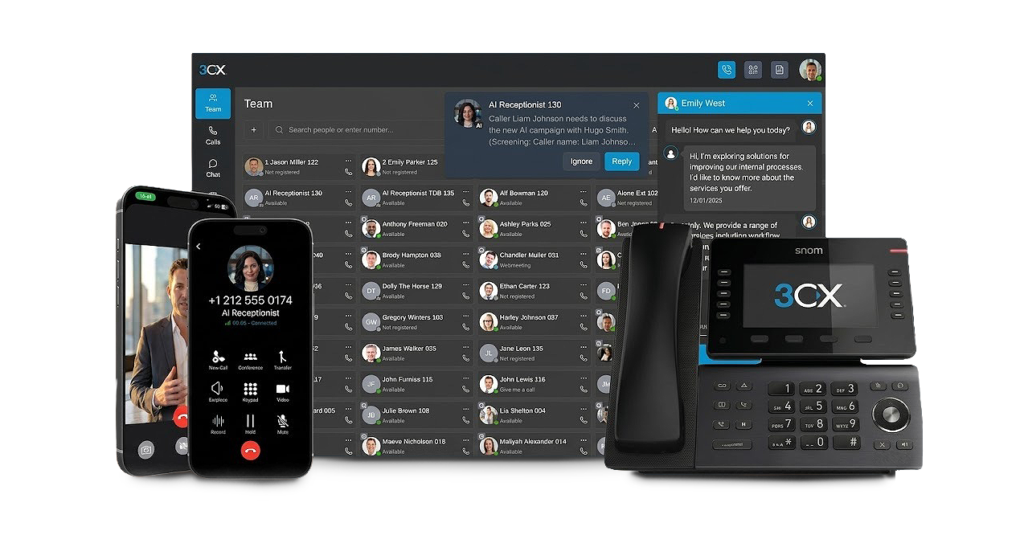
What is 3CX AI Edition and is it worth upgrading to? 3CX AI Edition (renamed from Enterprise/AI Edition in April 2026) is the top commercial tier of 3CX, including everything in PRO Edition plus a four-component AI feature suite: (1) AI Receptionist (handles inbound calls without a human), (2) AI Personal Assistant (per-user voicemail and call summarization), (3) AI Agents (configurable AI handlers for specific workflows), and (4) AI Transcription (with bring-your-own-provider support for OpenAI, Grok in V20 Update 9, or self-hosted) — which also drives sentiment scores and call summaries that surface inside 3CX’s existing reports across call logs, extensions, ring groups, and queues. Whether AI Edition is worth the upgrade depends on actual use case — businesses receiving high inbound call volumes that could be deflected by an AI receptionist, or sales/service teams that would meaningfully benefit from automatic call summaries, typically see ROI within months. Businesses without those use cases are usually better served staying on PRO Edition. Critically, 3CX’s bring-your-own-AI architecture means customers aren’t locked into a single proprietary AI stack the way Microsoft Teams Phone, RingCentral, or Dialpad customers are.
What’s Actually in AI Edition
The April 2026 rename from Enterprise/AI Edition to simply AI Edition was more than cosmetic. It clarified the value proposition: this is the tier that includes AI features. Everything else stayed the same.
The AI feature set breaks down into four components, each solving a different problem. (For broader context on what AI is doing across business phone systems generally — well beyond just 3CX — 10 Ways AI Is Transforming Business Phone Systems covers the wider landscape.)
AI Receptionist
The AI Receptionist answers inbound calls and handles routine routing without involving a human. Callers describe what they need; the AI directs them to the right department, person, or self-service answer. For businesses with high inbound volume on simple questions (“what are your hours,” “where are you located,” “can I speak to billing”), the deflection rate is the metric that matters. A receptionist that handles 30% of inbound calls without human involvement frees the actual front-desk staff to do work that requires judgment. (For the broader “is this worth it” question across all AI auto-attendant implementations, AI Auto Attendants: Worth the Upgrade or Expensive Overkill? walks through the realistic decision criteria.)
AI Personal Assistant (AI PA)
The AI PA is the per-user version: voicemail transcription, call summarization, and meeting note generation tied to an individual’s extension. The realistic ROI calculation is straightforward — if a salesperson takes 25 calls a day and previously spent 2-3 minutes per call typing notes into a CRM, AI summarization saves roughly an hour per day per rep. At scale, that’s the kind of feature that pays for the entire edition upgrade. (AI Call Summarization ROI: Real Time & Cost Savings Data breaks down the per-employee time savings with actual data — averaging 3.2 hours per employee per week across studied deployments.)
AI Agents
AI Agents are configurable AI handlers for specific workflows — appointment booking, order status lookups, basic troubleshooting flows, or first-pass intake before a human takes over. These are the most flexible of the AI features and the most variable in actual ROI: implementations that solve a real bottleneck deliver clear value, while implementations that try to AI-ify a process that wasn’t really a bottleneck just add complexity.
AI Transcription
This is where 3CX differs structurally from competitor platforms. AI Transcription supports multiple providers:
- OpenAI (currently supported) — high capability, moderate cost
- Grok (added in V20 Update 9) — significantly lower cost than OpenAI or 3CX’s own cloud transcription
- Self-hosted — for businesses with strict privacy or data residency requirements
Customers pick the provider based on their priorities. A high-volume business optimizing for cost picks Grok. A regulated business optimizing for privacy picks self-hosted. A business prioritizing capability picks OpenAI. The phone system stays the same; only the AI provider changes.
The transcription engine also drives the analytical layer that surfaces inside 3CX’s existing reports. When AI is enabled, sentiment scores and call summaries appear automatically in Call Log, Extension Statistics, Ring Group, and Queue Answered Calls reports — meaning supervisors can spot trends in customer satisfaction by agent, queue, or ring group without leaving 3CX. The reporting isn’t a separate product; it’s the analytical output of AI Transcription, surfaced where supervisors already work. (Hidden AI Fees in VoIP covers the realistic cost math when AI features get rolled into UCaaS deployments — worth reading before assuming “AI is included” means “AI is free.”)
The Bring-Your-Own-AI Advantage
Most UCaaS platforms in 2026 have made the opposite bet from 3CX. Microsoft Teams Phone’s AI features only work with Microsoft’s Copilot stack. RingCentral’s AI features only work with RingCentral’s models. Dialpad built its entire platform around its proprietary Dialpad AI.
The vendor-locked approach has one structural problem: AI is moving faster than UCaaS platforms can. The transcription provider that was best in 2024 isn’t the best in 2026. The model that’s cheapest this quarter won’t be cheapest next quarter. Locking the phone system to a single AI vendor means the customer either accepts whatever the vendor ships, or replaces the phone system every time the AI landscape shifts. (Generative AI in UC & VoIP: What’s Real, What’s Hype? covers the broader landscape of AI claims in UCaaS — useful context for separating real capability from marketing.)
3CX’s architecture sidesteps that problem entirely. The phone system handles voice and call routing. The AI provider — whichever one fits the customer’s current needs — handles transcription, analytics, and intelligent features. When a better AI provider emerges, the customer changes the integration without changing the phone system. That’s structurally more durable than vendor-locked AI, and it’s a real differentiator that doesn’t get talked about enough.
When AI Edition Is Worth the Upgrade
Honest take: AI Edition is the right tier for some businesses and an unnecessary expense for others. The decision should turn on actual use cases, not on the general impulse that “AI is the future.”
AI Edition is worth it if any of the following apply:
- High inbound call volume on simple questions that could be deflected by an AI receptionist (typical for retail, healthcare scheduling, professional services intake)
- Sales or service teams large enough that automatic call summarization saves meaningful aggregate time
- Contact center operations where sentiment analysis and trend reporting drive coaching and process decisions
- Businesses with regulatory or compliance reasons to transcribe calls (financial services, healthcare, legal) — at which point the AI provider choice (self-hosted vs. cloud) becomes part of the compliance calculus
AI Edition is probably overkill if:
- Inbound call volume is low enough that a human receptionist is faster than configuring AI flows
- Outbound calls are the primary use case and existing CRM integration handles the call notes
- The business doesn’t have the bandwidth to actually configure and tune AI features (AI features that aren’t tuned generate frustration faster than they generate ROI)
For businesses in the second category, PRO Edition is the correct fit — and the cost difference goes back into the business instead of paying for features nobody uses.
What AI Edition Costs
3CX uses simultaneous-call (SC) licensing, not per-user. The AI Edition price scales with the number of concurrent calls the system needs to support — a 16SC license costs less than a 64SC license, and the right SC count depends on actual call concurrency, not headcount.
The Q2 2026 Spring Promotion offers up to 30% off upgrades, renewals, and new licenses across all editions through the end of the quarter. That’s a real pricing window for businesses considering an AI Edition upgrade.
For full pricing detail across all four editions and the realistic total-cost-of-ownership math when hosting and SBC are factored in, 3CX Pricing 2026: What the New Editions Actually Cost covers the complete picture.
How Techmode Approaches AI Edition
Techmode doesn’t sell phone systems like commodity hardware. The company delivers communication outcomes backed by infrastructure that’s designed around the assumption that the right edition is the one that fits the actual use case — not the one being marketed hardest. Every TechmodeGO deployment runs on private, triple-redundant AWS instances with 99.999% uptime, and every edition recommendation is based on what the business actually needs.
For AI Edition specifically, Techmode’s Premier Launch process includes a use-case assessment before the upgrade recommendation. If AI Receptionist will deflect 30% of inbound calls, that’s a clear case for AI Edition. If the business has a low inbound volume and a manual call-notes process that’s already working, PRO is the right answer and the AI Edition upgrade gets shelved until something changes. Techmode’s Concierge Services team is U.S.-based and handles the AI feature configuration and ongoing tuning that actually drives ROI — not just “the AI is enabled” but “the AI is delivering measurable value.” That’s part of why Techmode maintains an NPS of 85, more than double the industry average, alongside an A+ BBB rating.
The bring-your-own-AI architecture also means Techmode can recommend the right AI provider for each client — Grok for cost-conscious deployments, OpenAI for capability-first deployments, self-hosted for privacy-first deployments — without requiring a phone system change to switch providers later.
Want a quick assessment of whether AI Edition is the right tier for your business? Schedule a free consultation and Techmode will map your actual use cases against what each edition delivers.
Frequently Asked Questions
Q: Is 3CX AI Edition the same as Enterprise Edition?
A: Yes. In April 2026, 3CX renamed Enterprise/AI Edition to simply AI Edition. The capabilities stayed the same; only the name changed. The rename was driven by 3CX’s recognition that “Enterprise” was misleading for businesses purchasing the edition for AI features without considering themselves enterprise-sized. For the full context, see What Changed With 3CX Licensing in April 2026.
Q: What’s the difference between AI Edition and PRO Edition?
A: AI Edition includes everything in PRO plus the four-component AI feature suite — AI Receptionist, AI Personal Assistant, AI Agents, and AI Transcription (which also drives the sentiment scores and call summaries that surface in 3CX’s existing reports). PRO covers advanced call handling, queues, reporting, and CRM integration without the AI layer. Businesses without an AI use case can usually stay on PRO without losing core functionality.
Q: Which AI provider should I choose for transcription?
A: It depends on priorities. Grok (added in V20 Update 9) is the cost-optimized choice — significantly cheaper than OpenAI or 3CX’s own cloud transcription. OpenAI is the capability-optimized choice for businesses that want the highest transcription quality regardless of price. Self-hosted is the privacy-optimized choice for regulated industries or businesses with data residency requirements. 3CX’s architecture lets customers switch providers without changing the phone system.
Q: Does AI Edition replace the need for a separate contact center platform?
A: For lower-volume contact center operations (typically under 50 agents) without complex omnichannel requirements, AI Edition combined with V20 Update 9’s queue features (callback-on-request, time-based escalation, estimated wait times) closes most of the gap with dedicated CCaaS platforms. For higher-volume operations, multichannel customer engagement, or advanced workforce management, a dedicated CCaaS may still be the better fit. See UCaaS vs. CCaaS for the full comparison.
Q: What happens to ENT+ customers who paid for cloud transcription?
A: Existing ENT+ subscriptions continue to work, and customers can keep using ENT+ cloud transcription as long as they maintain the subscription. Customers with recently purchased ENT+ 16SC licenses who’d prefer to migrate to AI Edition with bring-your-own-provider transcription can request a refund through 3CX customer service. Techmode customers on ENT+ are reviewed individually for the right migration path based on transcription volume and provider preference.